Peptide Purity Resolution Innovative Peptides-peptide Drug Exploration
Comprehending Peptide Purity: What 99%+ Actually Means
During solid-phase synthesis, each amino acid coupling action has a yield of approximately 99-- 99.8%. When a coupling stops working, the expanding chain is capped to prevent more prolongation of the wrong series. The outcome is a peptide that's much shorter than meant-- missing one or more amino acids.A solitary generic chromatographic technique is commonly not nearly enough for peptides that are hydrophobic, very basic, very closely related in turn, or partly detoxified. We supply HPLC and UPLC pureness analysis workflows that focus on valuable separation rather than just generating a percentage. We create analytical workflows around the sample type, series functions, modification account, and choice context. Jobs might entail unrefined intermediates, purified peptides, stored lots, client-supplied materials, or products created with our custom peptide synthesis platform.
Peptide Practical Analysis In Biomedical Research
" Mass spectrometry answers "is the discovered substance regular with the intended peptide identity? " Together they provide more powerful batch-level evidence than either technique alone. In the common peptide COA context, peak purity usually describes the percentage of total chromatogram location represented by the major peptide optimal.
For groups that require deeper structural testimonial, the job can also be aligned with peptide series analysis and broader characterization support. Amino acid evaluation or other measurable techniques can sustain absolute web content. Chiral approaches can resolve enantiomeric pureness where stereochemistry is an issue. Residual-solvent or water-content tests can matter in manufacturing or security contexts.What Can We Give?
Peptide screening is the set of analytical checks made use of to review a peptide example before it is used in a research process. In functional COA review, the term generally describes purity screening, identification testing, and documentation evaluation. Purity screening asks how much of the found example is the primary peptide versus related contaminations. Identity testing asks whether the determined mass or sequence-related evidence matches the intended peptide. Paperwork review asks whether the record is batch-specific, deducible, and detailed enough to be examined. Peptide screening is the logical process used to confirm that a research study peptide is both pure and properly determined.By insisting on peptides that come with verification of pureness and identity, researchers can considerably reduce the risk of speculative artifacts. Alternatively, using peptides that have passed third-party lab validation helps make sure that the observed experimental impacts are genuinely because of the intended peptide and not because of impurities or errors. When you see peptides promoted as "research-grade," it describes their meant usage and the degree of manufacturing oversight. Research-grade peptides are produced laboratory study use only-- they are not generated under pharmaceutical GMP standards and are not implied for use as rehabs or in human beings. These peptides include a basic quality assurance plan, typically including HPLC pureness analysis and MS verification of identity, guaranteeing they meet clinical criteria for pureness and composition.
- Either can be appropriate, yet third-party testing is the gold criterion for research-grade materials.
- Our workflow is designed to relocate from sample context review to interpretable peptide data with very little analytical uncertainty.
- All items are cost research study, research laboratory, or logical functions only, and are not for human usage.
- FDA and the European EMA have developed standards mandating thorough analysis and quality assurance for peptide products to guarantee security and effectivenessr.
- Extremely few business study peptide providers provide MS/MS information on regular COAs-- it is typically scheduled for pharmaceutical-grade materials and progressed research study settings.
As the portion of organic solvent slowly increases throughout the run, particles are released from the column in order of their hydrophobicity-- the much more hydrophobic a peptide, the longer it requires to elute (wash off). Considering that impurities normally differ from the target peptide by a minimum of one amino acid, they have slightly various hydrophobicities and appear as separate peaks on the chromatogram. The key point is not to perplex purity (HPLC portion of the main peptide vs contaminations) with overall material. For experimental planning (like calculating molar focus), both pureness and web Helpful hints content are useful numbers, yet purity is what shows the chemical homogeneity of the peptide example.
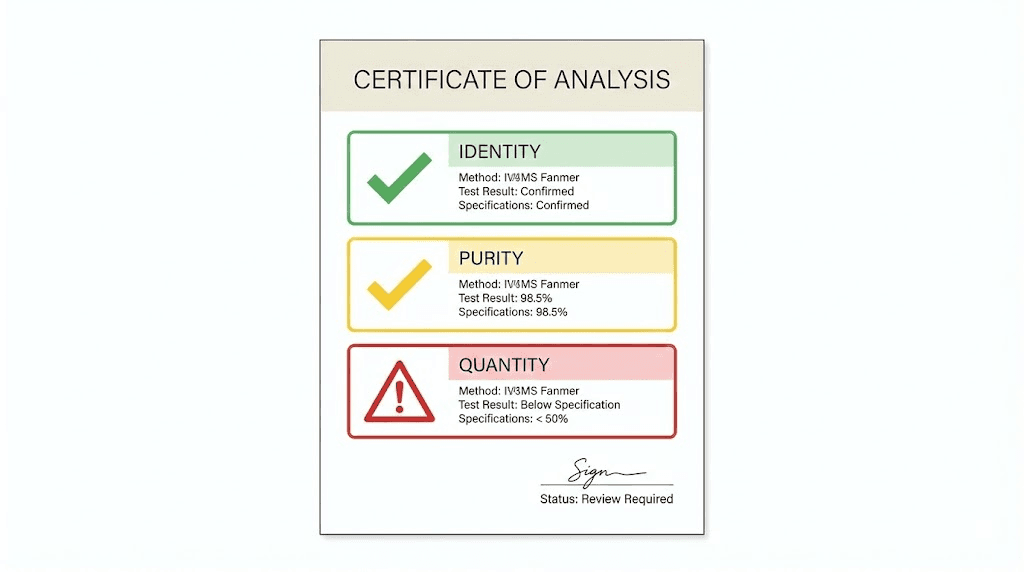

Examinations can be carried out using high-precision stabilization chambers, mimicing different settings, and using international criteria to research temporary and lasting stability, critical for consistent peptide performance. Some peptides stop working not due to the fact that the sequence is wrong, but due to the fact that their physical behavior in actual solvents is inadequately understood. We supply physical residential property screening that helps teams work better with difficult samples. Mass spectrometry validates whether the determined mass matches the anticipated peptide mass. The chromatogram is the most essential aesthetic information element on an HPLC peptide test report. It is a chart with time on the straight axis and detector response, typically UV absorbance, on the upright axis. Each peptide has a different expected molecular weight, so mass verification is not a common badge; it is compound-specific evidence. For a much deeper identity-focused explanation, see Mass Spectrometry Peptide Verification. Identity screening confirms that what was synthesized is really the desired sequence.